This is an ongoing documentation of my journey as a first time GM. As I find resources, I will document them, write articles of tips and tricks, link other blogs, podcasts, youtube videos and anything I can find that is helpful.
With a quick read over the rules and attempting to digest everything in the core rulebook, alignment was not even a topic I was thinking of. With the creation of a couple of characters I have used alignment, but have never really connected what the purpose of alignment was. So, as I was reading over the message boards on Paizo the other day I saw alignment come up several times. The thread I read about alignment progressed through a long debate about what alignment a person thought his character was, and why they thought the character was of a certain alignment. My next thought was, I must write about this, and here I am.
Here is the background about the character in question. The character had pledged himself to serve another because he wanted to repay for something the other character had done for his family. The pledge was for life and to do anything his new master commanded. He also stated his character wouldn't even flinch about being ordered to kill a child if ordered to do so.
This is what created all of the arguments in the thread. Some said that he was lawful evil and others claimed lawful neutral. The character described seemed like a robot to me, because the poster kept referring to this character will do whatever his "Lord" commands, but he never really delves into the emotions of his character and when asked, only goes back to "does anything he is commanded and would even kill a child," which makes me think he was probably trolling. This still created the thoughts that I need to understand this better, and through subsequent reading it became apparently obvious to me that the main thing people need to remember related to alignment is that it is meant to be a tool to help with your character development. This person totally misunderstands the use of alignment. He was trying to use it to run his character instead of developing the concept of his character. Maybe it's because his GM is trying to railroad him into things, or maybe like I stated before, he is a troll. Alignment can have influence later in the game, but please remember the main purpose is to help you develop, DEVELOP, your character. If you wonder where this concept of development comes from check out the third paragraph and first sentence in the additional rules chapter of the Core Rule Book.
Alignment Chart
There are two sets that combine to make 9 different categorizations of alignment.You have good versus evil and law versus Chaos. Each of these have neutral in between them. For Good versus Evil there is Good, Neutral, and Evil. For Law versus Chaos there is Law, Neutral, and Chaos. Combining these two sets gives you Lawful Good, Neutral Good, Chaotic Good, Lawful Neutral, Neutral, Chaotic Neutral, Lawful Evil, Neutral Evil, and Chaotic Evil. There are the 9 categories. Each of these are meant to be a broad guide.
I will break down each of these in subsequent posts and my last post will wrap it up with my "ULTIMATE" summary and wrap up of alignment.
I am going to tackle alignment next. Alignment is something I don't fully understand, and it seems to be a fairly frequent topic on the message boards on Paizo. So I am taking some extra time to digest it and come up with a nice overview!!
Image 2, Spell Cards with
Runed Parchment Background
While starting out a month ago searching for resources on the net, it seemed like there was not much out there, but with a lot of searching I have found that there are some amazing resources out there, if you can find them. While perusing the Paizo message boards I stumbled across this little gem www.thegm.org. It is by one of the guys that is on Know Direction podcast. He has created a web based Spell Card Generator.
The Spell Card Generator allows you to select your Class, Spell Level, and Spell Sources(Books). The spell sources include Core Rulebook, Advanced Players Guide, Ultimate Magic, Ultimate Combat, and the Advanced Race Guide.
He also gives you the capability of changing the background on the cards for a little bit of flavor, color of the spells with an option for auto color by school, and
Options when you print are: Card Size(Image 1), color by card school, and three choices for Card Background. The background choices are none, Runed Parchment(Image 2) and Arcane Background(Image 3).
Image 3, Spell Cards with
Arcane Background
I have not attempted to print yet, but he does give specific instructions on how to set print margins. He designed it to be set at 0.25 inch margins on US Letter sized paper or .75 cm margins on a size A4 paper.
If you think that you can only print cards from the books I listed previously, I have misled you. You can make custom cards, although you do have to do a little more lifting which having to input Spell Name, School, Subschool, Descriptor, Class & Spell Level, Casting Time, checkbox spots(for Verbal, Somatic, Material, Costly Components, and Divine Focus), Range, Area, Effects, Targets, Duration, Saving Throws, Spell resistances, and a Description box. And....all of the card printing customizations as there is with the other cards.
Image 4, Spell Cards from Spellbook 2 Alpha
This is definitely something I will be using in the future, and would recommend to my friends. He has a version 2 in alpha testing right now that prints out to pdf. It has a new layout(Image 4), but you do not have any options for the background at this time. Improved layout of text, with a large font option coming in the future. Do you want to print your spells out in a list instead of on cards, well it is coming. For the GM's he is working on random spellbooks. He will be giving the alpha version a facelift and improving the controls before officially launching it, but you can use the alpha version now if you would like. Additionally it adds 10 Pathfinder Player Companion sources, 10 Pathfinder Campaign Setting sources, and 20 Pathfinder Adventure Paths as sources. If you are using these sources, this would probably be the better way to go because filling in the custom cards will take quite a while.
Amazing Resource! If you have a caster class, you should check this one out!!
I just wanted to highlight the different resources that Paizo is providing for extension of the beginner box. These are free downloads available on Paizo @ Beginner Box and Resources.
Original Beginners Box(Not the Items for Download)
The Different free downloads are:
Beginner Box Player Pack
Has a new class, the barbarian and the layout is just like the beginner box.
Expansion of class options from the beginner box: Cleric Options, Fighter Options, Rogue Options, Wizard Options, additional feats, and more gear.
GM Kit
New Adventure
New Monsters
Magic Items
Some explanation on using published adventures
Transition Guide
If you get a new beginner box this was already included. You can download it for free though
Beginner Box Bash Demos
Very short 2 page scenarios for 1st level characters meant to be demos
4 included scenarios
Character Sheet
PDF copy of the character sheets from the beginner box
Pregenerated Characters
1st level copies of the included pregeneraged characters from the Beginners Box
Everything else on the page costs money...
These are all additional resources to expand on the Beginners Box. How can one complain about free products.
So, I was perusing Twitter for some awesome pathfinderness and I found out there is much more on Twitter than on the general Internet!!
His Twitter is @OMGitsGareth
Frenzy Kitty is his youtube channel, and he does general boardgames reviews. Great quality video and I agree that the Beginner Box is amazing and its a great value as I posted earlier!!
I was so confused today. I was looking at a Black Dragon, which is not all that unique with what I was confused about. So the base black dragons basic stats are the following:
CR 3; Size Tiny; Hit Dice 4d12
Speed 60 ft., swim 60 ft.
Natural Armor +3; Breath Weapon line, 2d6 acid
Str 11, Dex 16, Con 13, Int 8, Wis 11, Cha 8
So base Hit dice are 4 d12, great. I'm all good. So I want to move up to a Young Black dragon, and I refer to the Dragon Age Categories table. When you move up to the Young Black Dragon the hit dice column is Base + 4, Alright, so that is 4d12 + 4d12 and that makes it 8d12, wait a second, what is that +24 after the 8d12? This is where I was confused. I scoured the Bestiary, the Core Rule Book, The Beginner Books, and nada. I finally turned to the forums. What do you know, quick answer on the forums.
AC 21, touch 12, flat-footed 19 (+2 Dex, +9 natural)
hp 76 (8d12+24)
Str 19, Dex 14, Con 17, Int 10, Wis 13, Cha 10
So it turns out if you take your Con of 17, and use the modifier: +3 and multiply that by the number of hit dice (8) you get 24 which is the extra hit points I was missing. So you use the average for the hit dice which is 6.5 and multiply that by the number of hit dice, 8, and then add the Con bonus times the number of hit dice and total that.
The equation is as follows
(Number of hit dice x Average of the die) + (Number of hit dice * Con bonus)
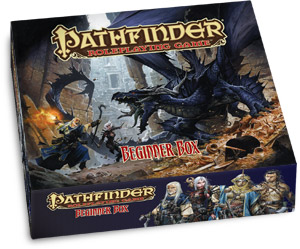
My entry into Pathfinder was with the Beginner box.
What is in the beginner box?
Game Master Guide-96 pages
Hero's Handbook-64 pages
Transition Guide (Next Step)
Map-double sided dry erasable
Pawns-80
Set of Red Dice-1 set of 7
Premade Characters-4
Here's a clip from Paizo going over the contents of the Beginner Box.
Game Master Guide
The Game Master Book is 96 pages, and is designed to get players from level 1 to level 5. It has amazing paper quality with some of the best artwork and layout I have seen among any roleplaying books, including any other books Paizo has released.
It starts out with a scenario, Black Fang's Dungeon, that uses the included flipmap and pawns(leaves you with plenty of unused pawns for future adventures). Next it has a section on game mastering, which as a new game master I found very useful. Subsequent chapters deal with how to use monster stat blocks(extremely basic), magic items, environments, a couple pages on the town of Sandpoint, a gamester's reference, and where to go from here which gives you ideas on creating your own adventure with Sandpoint being the hub. It is an amazing first step, and in my opinion the best value on the market. Is it perfect? No, it isn't perfect, there were times reading through it that I was not sure what was going on. It was answered later, but there were times I was confused. There is also a lot of information in the book considering its length.
Hero's Handbook
The players book has 64 pages, and starts with a short solo experience. It was a choose your adventure with some dice rolling. I think it is a great way to structure an intro to players. It gives some flavor and gives examples of how dice interact with the game. It also allows you to open the box and not have to have someone else around to start to experience some basic concepts.
In subsequent chapters it guides you through creating a character with basic races, and then into classes. Included classes are Cleric, Wizard, Fighter, and Rogue(pre-generated characters are included enabling you to jump straight into playing), with a basic selection of equipment, feats, skills, supplies, and spells. The next section is on how to play the game, which is 16 pages. It starts with how to play and ends with how to die and level up. Really dying is a couple pages before the end, but I like putting those in the same sentence.
Transition Guide
I have not fully read the transition guide yet, but it introduces a couple new concepts that are different in the full game, talks about going to level 6 and beyond, and how to read a stat block. Talking about the stat block....I still don't know how to read and understand all of the different stat block sections. I have a question out on the message boards now and hopefully will have that question answered today!
Pawns and Flipmat
I used to think that you had to have metal minis(I used to play a little 40k and Warmachine-Oh, and Warmachine is a far superior game), and I also play boardgames. You are probably saying "why is he mentioning that?" Last year a game came out called "Dead of Winter" and it had pawns instead of plastic or metal miniatures. I felt like the artwork added so much more than what minis would add since most minis are unpainted. An unpainted mini might as well be a piece of cardboard with a name on it. Okay, I'm exaggerating a little, but it did change my mind on mini's vs pawns. It added so much flavor and the price is right!!!!! The pawns are relatively inexpensive and add great flavor. I absolutely love them! The flip mat is awesome and I'm sure I'll get some extra use out of it in the future. I want as much flavor to be in my games as possible, and as little dry erase map creation as possible because I like the pretty maps!!!!
Overall Impression:
Overall, everything is high quality with amazing artwork. Did I mention that the artwork was great. Also, the layout is the best I have seen. Compared with the core rule book, the bestiary, or the game mastery guide, it makes them look like a preschooler made them. I really like the layout and the artwork. It is a really great start for roleplaying.
What could they improve on? The dice aren't to hot, but I understand price goes up quite a bit as you get nicer looking dice, and it's something that is an opinion. I'm sure someone out there is yelling "Awesome red dice!!"
If you're just starting out, this a great place to start. Also, it is pretty inexpensive in relationship to boardgames with a price of $34.99. Not bad at all!
I have only ever played one session of roleplaying. For some reason role playing intrigues me. The past few years my wife and I have become huge board game fanatics and this renewed my interest in something broader and grander than the limits of boardgames. This lead me to starting to looking into roleplaying books. I had previously bought D&D 3.5, and it quickly died shortly after I bought the books. Seeing that they just released 5 really turned me off of looking at anything produced by Wizards of the Coast. The books are way to expensive for me to spend my money to have them stop supporting the system and move on and make me buy new books. Then, I found Pathfinder, and the realization that my old books aren't completely useless and I may be able to glean some information from them.
I ran out to my local game store and promptly picked up the Pathfinder beginner box to give it a try. Historically I have had metal miniatures for different games I have played. This box came with cardboard pawns, which...ARE AMAZING!!! I used to think that metal miniatures were the way to go, but recently I picked up a game called Dead of Winter, and the flavor the different artwork brings to the game is awesome. I love being able to differentiate the different people or things from each other with a lot of flavor.
I ran a game with my wife and one of my best friends. I ran the module that came with the beginner box. I feel like I did okay for not having looked over it before I ran it, which I did purposefully with a misunderstanding behind running it. I had read that it would teach you as you go, which it does guide you through some different scenarios and the artwork and the quality of the book is amazing, although my did have a wrinkle in the first 10 pages of the game master manual. So, how did it go? A little rough, and I still feel lost where to go from here slightly.
So, what did I do? I ran out and bought the Core Rule Book.....Whoa!!!! That is a ton of information. After glancing through it, and skimming different sections I started checking if there would be interest in running a campaign, and there was. First thought was, there is no way I'm running a home-brew campaign, although that seems to be what a lot of people recommend. I have never GM'd and really have extremely limited experience(now 2 sessions) of roleplaying.
Since there was interest, I ran out and bought Rise of the Rune Lords, after talking with someone at the FLGS about what adventure paths would be good for a first time Game Master, with really no
experience in roleplaying. I liked that he said that Rise of the Rune Lords introduces many of the monsters with flavor that is different from other worlds, and that it would work well for a new Game Master. Over the next couple weeks I picked up the Campaign Setting The Inner Sea, the GameMastery Guide, and Bestiary I.
If I wasn't overwhelmed, which I was, I am really overwhelmed now. Although I would have to add quite giddy. After scouring the forums of Paizo, which I really don't like their format, I found they have a wealth of information about each adventure path which is great. Wonderful amounts of details as well as examples of what to focus on to get your players tied in and stumbling stones that different people have experienced running Rise of the Runelords.
I am going to record my experiences as a new Game Master here, as well as documenting resources that have helped me. My next post will be how I made my own game master screen. It was not my idea, but I can see many alternatives that could be done and will put links to where I got my ideas and also what I have included as reference. I know as time goes on, I will need fewer tables on the back of my game master screen, but this is aimed at people getting into the hobby and my experiences.